Incident Root-Cause Copilot
Multi-agent AIOps system designed to correlate anomalies, recent changes, and historical incidents to support root-cause analysis.
- FastAPI
- React
- Docker
- Observability
Overview
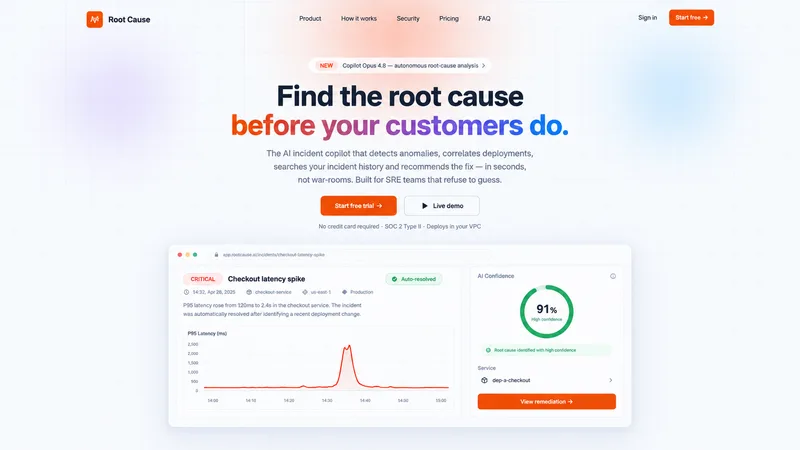
Root Cause is a personal project: an AI incident copilot for SRE teams. It detects anomalies, correlates them with recent deployments, searches past incidents, and recommends a fix. Specialised agents each investigate one source of evidence, and their findings are combined into a root-cause hypothesis with a confidence score.
The Problem
During an incident, engineers must manually connect metric anomalies, recent deployments or configuration changes, and knowledge from past incidents. That context switching takes time when it matters most.
Architecture
Signals
- Service metrics
- Deployments & changes
- Incident history
Agents
- Anomaly detection
- Change correlation
- Incident history search
Analysis
- Root-cause hypothesis
- Confidence score
- Recommended remediation
Interface
- React incident view
How It Works
- 1
Detect
Anomalies, such as a latency spike in a service, are detected from metrics.
- 2
Correlate
Agents check deployments and changes made around the time of the anomaly.
- 3
Search history
Similar past incidents are retrieved to add context.
- 4
Recommend
A root-cause hypothesis with a confidence score and suggested remediation is shown.
My Contribution
- Designed and built the project end to end.
- Developed the multi-agent backend with FastAPI.
- Built the React interface for exploring incidents and correlated evidence.
- Containerised the services with Docker.
Engineering Challenges
- Splitting the investigation into agents with clear, non-overlapping responsibilities.
- Presenting each hypothesis with its evidence and a confidence score, so the output stays verifiable.
Lessons Learned
- Agent systems are easier to trust when every conclusion links back to its source signals.